
Technology
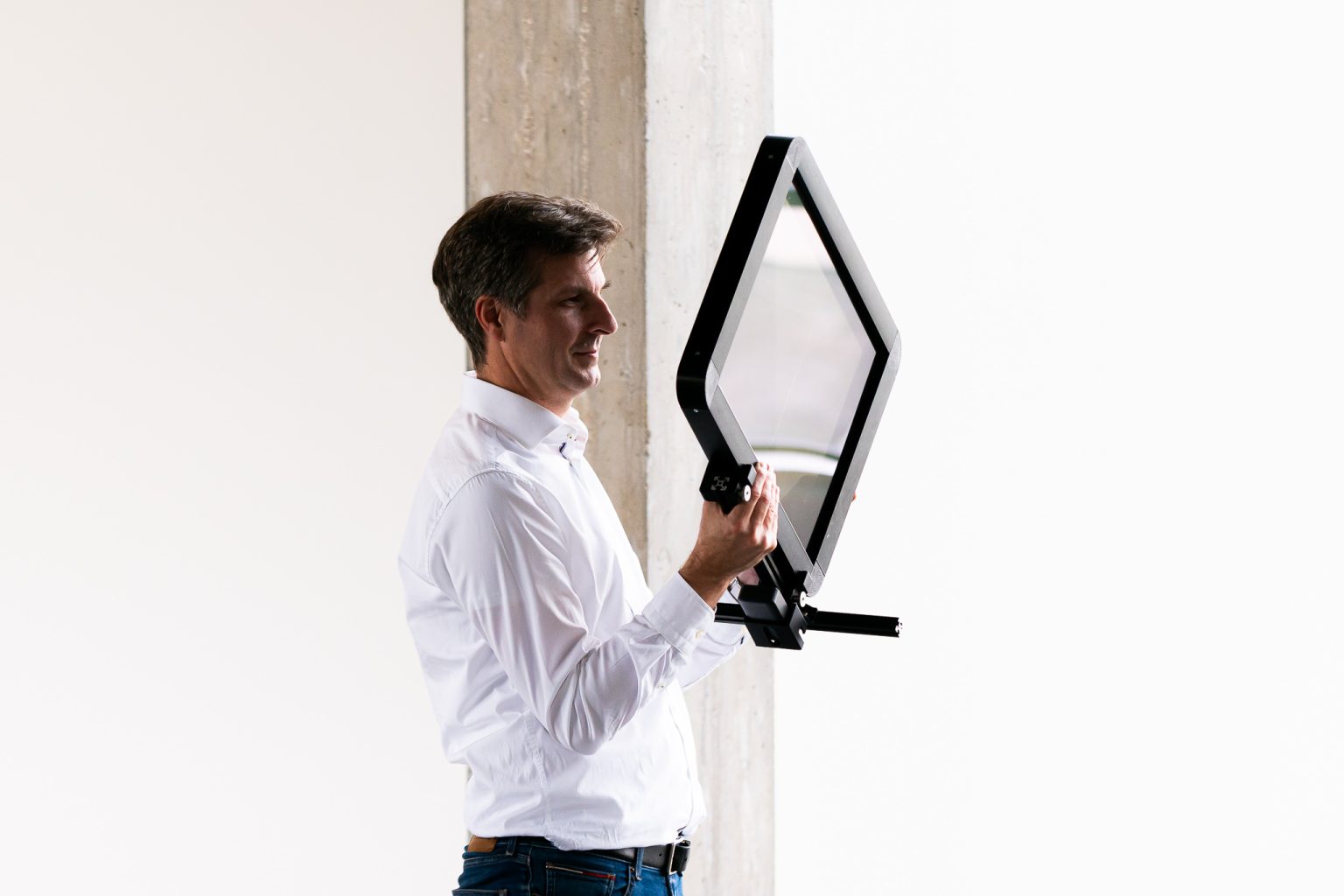

eLstar’s ELM (Electrophoretic Light Modulator)
Powered glass dynamically adapts to manage light and heat, reducing energy consumption and enhancing comfort. More efficiency, less environmental impact.
Unlike Electrochromic smart glass technologies, ELM relies on the physical movement of pigment particles rather than an ion-exchange reaction. This distinction is the foundation for the performance differences described below, from optical range, switching speed to long-term durability.
ELM vs. other technologies: what’s the difference?
Most dynamic glazing on the market today is either electrochromic (EC), SPD (suspended particle device), or PDLC (polymer dispersed liquid crystal). Each uses a different mechanism to control light transmission:
Electrochromic (EC):
relies on chemical ion exchange between layers. Switching time scales with device size. For windows EC is typically slow (minutes), non uniform and often leaves a residual blue or yellow tint even in the "clear" state.
SPD:
suspended particles align under voltage; fast switching, but typically limited to a hazy/frosted clear state rather than true neutral clarity. SPD is also limited by high power consumption and high voltage integration requirements
PDLC:
liquid crystals dispersed in a polymer matrix; good for privacy switching (clear-to-opaque) but not designed for solar/heat control.
eLstar’s ELM:
a pigment-based system that redistributes particles across the active area using electric fields. This achieves a neutral, colorless clear state and fast switching speeds independent of panel size. Additionally, ELM offers a very wide optical range from 0.2% to 70%.
Why it matters:
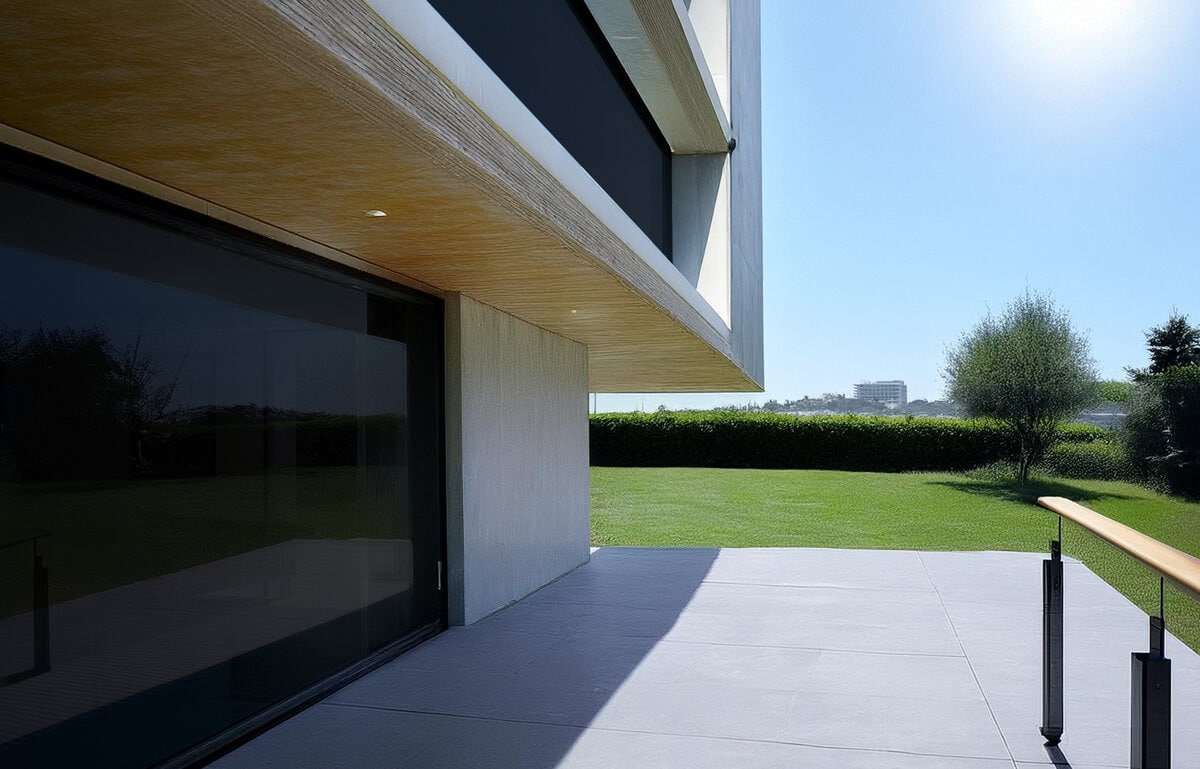
a neutral clear state means smart glass for architectural facades isn’t compromised by a permanent tint, and consistent switching speed means large curtain wall installations behave the same as small windows. The optical dynamic range is also essential to tackle energy savings and well being. The window is never too transparent to prevent overheating or too dark to prevent cool environment and early perceptions of evenings.
Smart glass technology comparison at a glance
This table is a useful reference for specifiers comparing dynamic glazing technologies side by side, and reinforces why ELM outperforms first-generation smart glass.
| Features | Electrochromic (EC) | SPD | PDLC | eLstar ELM |
|---|---|---|---|---|
| Switching mechanism | Chemical ion exchange | Suspended particle alignment | Liquid crystal alignment | Electrophoretic pigment redistribution |
| Typical switching speed | 2 to 20 minutes | Seconds | Seconds | Under 30 seconds |
| Clear state appearance | Residual blue or yellow tint | Hazy or frosted | Hazy or frosted (opaque state) | Neutral grey |
| Best suited for | Solar shading, slow-transition facades | Fast privacy or light control | Clear to opaque privacy switching | Solar shading and privacy with a neutral, glare-free clear state |
| Size and shape flexibility | Limited by uniformity at scale | Moderate | Moderate | Up to 2.9 m x 3.3 m, including trapezoids and circles |

Neutral tint
Clear in < 30 sec

Widest tint range
0.2% Dark – 70% Clear

Largest sizes
2.9 m X 3.3 m

Shapes enabled
Trapezoids and circles

Attractive color
Neutral grey

Low power
1W / m2

How does our eclipse dynamic glass technology work?
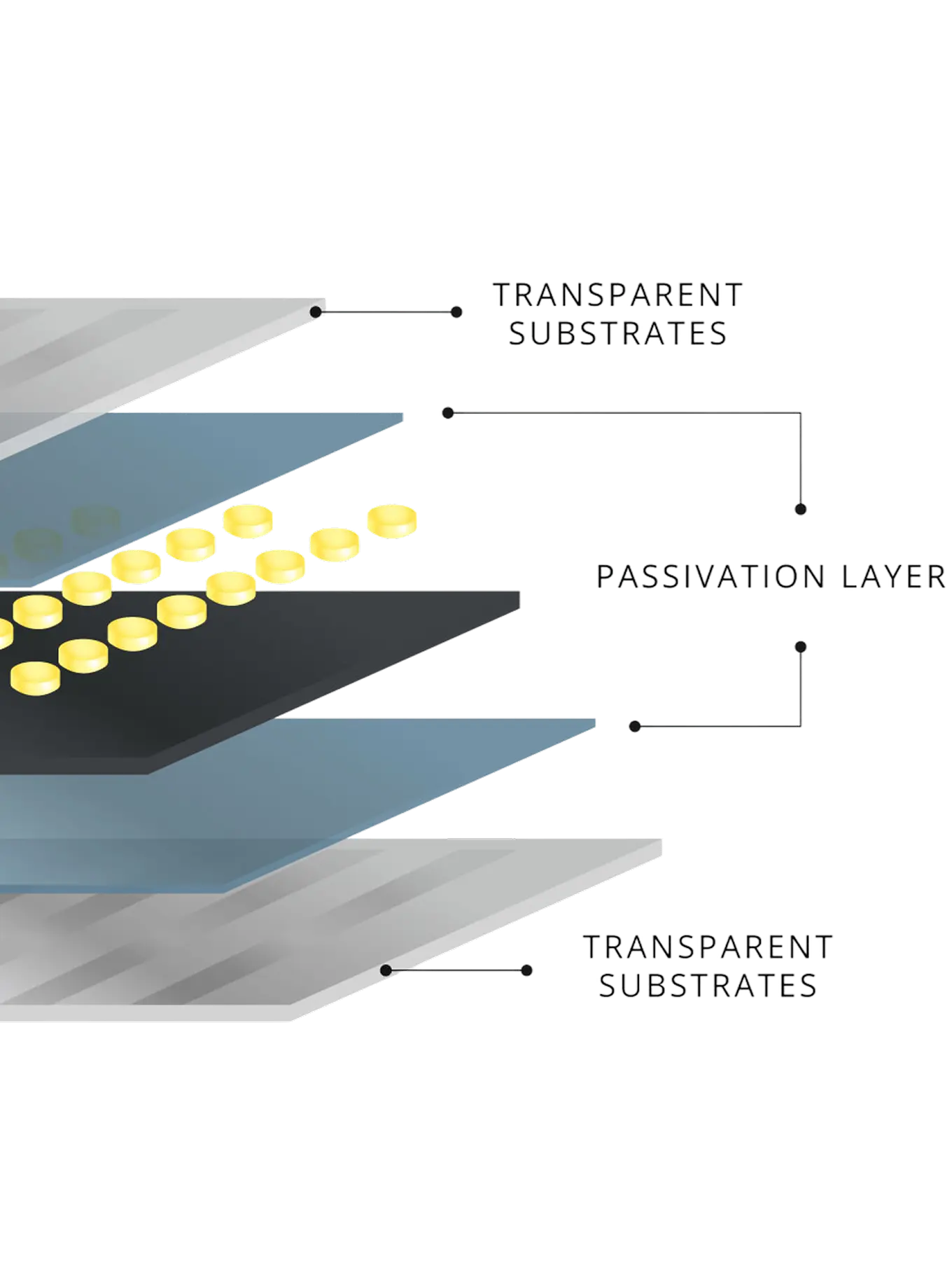
eLstar’s adaptive glass configuration is powered by our innovative ELM technology, which uses electric fields to aggregate pigment particles into areas that are invisible to the human eye, then redistribute them uniformly across the entire active area. This process enables precise and unlimited modulation control, dynamically adjusting light transmission levels to suit each specific application.
The science behind ELM: how electrophoretic light modulation works
At the core of eclipse glazing is a colloidal suspension: engineered pigment particles dispersed within a proprietary fluid, sandwiched between two conductive layers. This is where eLstar's material science expertise, from pigment surface engineering to dispersion development, translates directly into product performance.
When a voltage is applied, the electric field drives the charged pigment particles to concentrate into micro-scale zones that sit outside the human eye's resolution, effectively clearing most of the active area. Modifying the the electrical field allows the particles to redistribute uniformly across the surface, returning the panel to its tinted state. Because this process is driven by an electric field acting on particles already suspended in the fluid, rather than a chemical reaction that has to propagate through a solid-state layer, it scales far more predictably across large surface areas.
This is also why panel size does not materially affect switching time: the particles across the entire active area respond to the applied field at effectively the same rate, rather than the tint having to migrate from one edge of the panel to the other. It's a structural reason, not just an engineering tweak, for why eclipse™ glazing avoids the curtain effect described below.
The stability of this system over tens of thousands of switching cycles depends on rigorous quality control during production, including particle size distribution analysis (DLS), thermal stability testing (TGA), and optical characterization (UV-Vis) at each stage of manufacturing.
Switching speed and the "curtain effect" in large-format glazing
One of the most common technical objections to dynamic glass in large architectural applications is uneven switching: panels that darken from the edges inward, creating a visible "curtain" moving across the glass.
eclipse™ dynamic glazing is engineered so that transition speed is independent of panel size. Whether it’s a small residential window or a 2.9 x 3.3 m architectural panel, the entire surface changes state uniformly. This is critical for:
Curtain wall facades
Where visual consistency across large spans is a design requirement. See smart glass for architectural facades.
Automotive sunroofs and glazing
where uneven tinting is both an aesthetic and safety concern. See smart glass for automotive glazing.
Can eclipse™ glazing help buildings achieve LEED, BREEAM, or WELL certification?
Yes. Solar heat gain is one of the largest contributors to a building’s cooling load. eclipse™ dynamic glass blocks up to 80% of solar heat gain, which can reduce HVAC-related energy consumption by up to 30%.
This directly supports point-scoring in major certification frameworks:
- LEED: Energy & Atmosphere credits
- BREEAM: Energy category credits
- WELL: Thermal comfort and light quality credits
For Benelux projects, this performance data also feeds into MPG (milieuprestatie gebouwen) calculations. Learn more about how this applies across our markets.
As sustainability requirements tighten across the architecture and construction sector, project teams increasingly need glazing that contributes measurable, documented energy performance data rather than a general claim of "energy efficiency." Because eclipse™ dynamic glazing’s solar heat gain reduction and HVAC impact are quantified, that data can be used directly in the energy modelling that certification assessors require, rather than being treated as a supporting or secondary material.
Is eclipse™ smart glass compatible with standard lamination processes?

Yes. The eclipse™ light modulator is designed as a thin insert that integrates into standard lamination lines using PVB or EVA interlayers, the same materials glass processors already use. This means no new cleanroom infrastructure, no new autoclave investment, and minimal process changes for smart glass for glass processors and fabricators using existing fabrication lines.
Manufacturing quality and consistency
Every batch of the pigment dispersion used in eclipse™ glazing is validated using a combination of analytical techniques before it reaches the lamination line. FTIR spectroscopy confirms chemical composition, GPC/SEC verifies polymer molecular weight distribution, and TGA characterizes thermal stability under the temperature ranges the finished glazing will face in service. This level of quality control is what allows eLstar to guarantee consistent optical and switching performance from panel to panel, and from batch to batch, which matters as much to a glass processor running a production line as it does to an architect specifying glazing for a single landmark facade.
How durable is ELM pigment-based technology in extreme temperatures?

Durability is a decisive factor for both architectural facades and automotive glazing, which face very different but equally demanding environmental conditions.
eLstar's pigment-based ELM technology is lightfast and does not degrade under prolonged UV exposure, and is engineered to perform reliably across a wide temperature range, maintaining consistent switching performance in hot climates (automotive and facades) and cold climates (residential and architectural).
This matters over the full service life of a glazing product. A facade or vehicle window is expected to switch reliably for years, through repeated heating and cooling cycles and constant UV exposure, without the tint shifting, the switching speed degrading, or the panel losing uniformity. Because ELM's pigment particles are chemically stable rather than reliant on a redox reaction that can degrade over repeated cycles, the technology is inherently well suited to this kind of long-term, high-cycle use.
Where eclipse™ technology is used
ELM’s combination of neutral clarity, fast and uniform switching, and flexibility in size and shape makes it suited to a broad range of applications:
Architecture
Facades, curtain walls, and skylights where solar control needs to be balanced against unobstructed views and consistent aesthetics across large glazed surfaces.
Automotive
Sunroofs and glazing where fast, uniform switching is both a comfort feature and a safety requirement.
Residential
Windows and doors where homeowners want on-demand privacy and glare control without blinds or curtains.
Glass processing
Fabricators integrating eclipse™ inserts into standard lamination lines to produce smart glass at scale.
F.A.Q.
Most traditional smart glass relies on chemical ion exchange that is often slow and results in a permanent blue or yellow tint. eLstar’s Electrophoretic Light Modulator (ELM) technology uses a pigment-based system which can achieve a perfectly neutral clear state and significantly faster switching speeds, providing a more aesthetic and responsive solution for modern facades.
Speed and uniformity are critical for user comfort. Eclipse™ dynamic glass switches states in seconds. This transition speed is independent of the panel size, ensuring that large-scale architectural windows and automotive sunroofs change uniformly without a "curtain effect."
Yes. Energy efficiency is a primary driver of our technology. By blocking up to 85% of solar heat gain, our glass reduces the energy required for HVAC cooling by up to 30%. This direct reduction in operational carbon helps projects earn significant points toward LEED, BREEAM, and WELL certifications, supporting the global shift toward net-zero building standards.
We designed our technology with glass processors in mind. The eclipse™ light modulator is a thin insert that integrates seamlessly into standard lamination lines using PVB or EVA interlayers. This allows fabricators to produce high-performance smart glass using their existing cleanrooms and autoclaves, removing the need for expensive new manufacturing infrastructure.
Durability is essential for both architectural and automotive applications. Our pigment-based ELM is inherently robust and lightfast, meaning it does not degrade under intense UV exposure. The technology is engineered to operate reliably in a wide temperature range, ensuring consistent performance in the most demanding climates and environments.